
Acrylic Sports Court Construction in Southeast Asia: Full Project Guide 2026
Most sports facility developers, school administrators, and local contractors in Southeast Asia share the same confusion: why do standard acrylic sports court construction projects fail so quickly in tropical regions? Many overseas construction guides only suit dry, temperate countries, not Southeast Asia’s year-round high heat, heavy monsoons, and extreme humidity. With 5 years of professional experience in acrylic sports court construction in Southeast Asia, we have completed hundreds of school, community, and club court projects across Malaysia, Thailand, Indonesia, and Vietnam. We know exactly what construction standards work for tropical climates, and what mistakes will cause new courts to crack, bubble, or fade within one year.
This complete guide covers professional acrylic sports court construction standards, climate-specific construction processes, common project pitfalls, and ITF-certified material requirements for Southeast Asia. No generic AI templates, only real on-site construction experience and practical advice for new court building projects.
What Makes Acrylic Sports Court Construction in Southeast Asia Different
Ordinary acrylic sports court construction methods are designed for mild climates with stable temperatures and low humidity. However, acrylic sports court construction in Southeast Asia faces three unique environmental challenges that completely change the entire construction logic.
First, high ultraviolet radiation accelerates surface aging. Tropical regions receive 8 to 10 times stronger UV rays than European and American regions, which requires anti-UV construction formulas and pigment configurations during acrylic sports court construction in Southeast Asia.
Second, frequent temperature expansion and contraction brings structural pressure. The surface temperature of outdoor courts can reach 60°C in the daytime and drop sharply at night. Only flexible construction materials and professional base treatment can avoid structural cracking.
Third, long-term high humidity and rainy seasons lead to hidden moisture in the foundation. Ordinary construction processes that ignore moisture isolation will cause large-area bubbling and delamination after the court is completed. This is also the most common quality problem in unprofessional acrylic sports court construction in Southeast Asia.
Standard Process for Acrylic Sports Court Construction in Southeast Asia
Based on our long-term on-site project experience, we have summarized a set of tropical-adapted construction processes exclusive to Southeast Asia. This standardized construction procedure ensures the new acrylic court can achieve stable performance for 8 to 12 years, fully meeting daily training, school sports meetings, and regular competition needs.
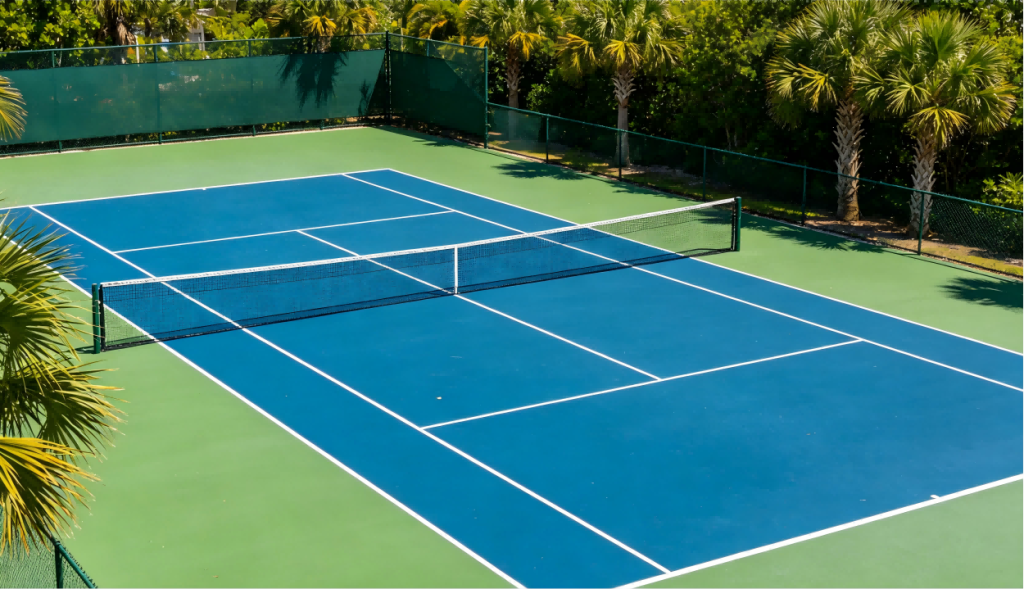
1. Foundation Inspection and Pre-Construction Treatment
The foundation determines the service life of the court, which is the core link of acrylic sports court construction in Southeast Asia. Before construction, we must test the flatness, hardness, and moisture content of the concrete base. For Southeast Asia’s humid environment, we strictly control the foundation moisture content below 4%. For newly poured concrete, we insist on sufficient curing time to avoid residual water vapor inside the base.
We also repair tiny cracks and uneven ground in advance and completely clean dust, oil stains, and floating mortar on the surface. Many low-quality construction teams skip detailed foundation treatment to save time, which directly leads to overall quality failure of the acrylic sports court construction in Southeast Asia after completion.
2. Tropical Moisture-Proof Primer Construction
Different from conventional construction, acrylic sports court construction in Southeast Asia must add a professional humidity-resistant and moisture-locking primer layer. Ordinary universal primers cannot adapt to damp concrete in tropical areas, resulting in poor bonding between the acrylic layer and the base.
Our ITF-certified supporting primer can effectively lock the residual moisture of the foundation, form a stable isolation layer, and solve the bubbling and peeling problems caused by high humidity from the source. In a school construction project in Penang, Malaysia, we used this professional primer process. After two monsoon seasons, the court foundation is still stable without any delamination.
3. Acrylic Structural Layer Paving
The structural layer is the main body of acrylic sports court construction in Southeast Asia, including the flexible base layer, stable middle layer, and wear-resistant surface layer. We adopt layered batch scraping and layered drying construction to ensure each layer is fully solidified before the next construction, avoiding water vapor trapping between layers.
Aiming at tropical temperature changes, we use high-elasticity modified acrylic raw materials to ensure the court has enough ductility to cope with thermal expansion and contraction, effectively preventing structural cracking. Different from rigid ordinary materials, our climate-adapted formula maintains stable toughness in high-temperature and high-humidity environments.
4. UV-Resistant Color Coating and Line Marking
Fading is a major flaw of inferior acrylic court construction in tropical areas. In the later stage of acrylic sports court construction in Southeast Asia, we use ITF-standard UV-stabilized color pigments. This formula can resist long-term strong sun exposure and maintain bright and uniform color for many years.
The final court line marking adopts weather-resistant professional coating, with clear lines, strong adhesion, and no falling off, meeting the standard requirements of conventional tennis and basketball court competitions.
3 Typical Construction Mistakes That Ruin New Acrylic Courts
In our 5-year project tracking, most failed acrylic sports court construction in Southeast Asia is not a material problem, but irregular construction operation:
First, rushing the construction period in rainy and humid weather. Many contractors construct in humid and rainy days for progress, resulting in excessive water content inside the court layer, which will bubble in large areas after sunlight exposure.
Second, omitting the moisture-proof primer process. In order to reduce costs, some projects directly pave acrylic on the original concrete, completely ignoring the humid climate characteristics of Southeast Asia.
Third, using non-standard ordinary materials. Universal acrylic materials for temperate zones cannot resist tropical UV and humidity, leading to rapid aging and damage of new courts.
Why ITF-Certified Materials Are Necessary for Court Construction
For formal school projects, community supporting facilities, and club competition venues, ITF certification is the core standard for qualified acrylic sports court construction in Southeast Asia. ITF-certified acrylic materials have stable ball rebound, anti-slip performance, and weather resistance, which not only meet daily use but also support formal sports events.
More importantly, certified professional formulas are specially optimized for high-temperature and high-humidity environments, which can perfectly adapt to the extreme weather of Southeast Asia and avoid various quality problems of ordinary courts. A sports club project in Jakarta chose our ITF-certified acrylic sports court construction solution. After three years of use, the court has no cracking, no fading, and no bubbling, which has been highly recognized by the customer.
Final Thoughts
Professional acrylic sports court construction in Southeast Asia is never a simple universal paving process. It needs targeted construction processes, moisture-proof measures, and climate-adapted material formulas according to tropical high temperature, high humidity, and strong UV characteristics.
After 5 years of deep cultivation in the Southeast Asian market, we have summarized a complete set of mature construction systems suitable for local climates, with stable ITF-certified material quality and hundreds of successful project cases. If you are planning new school, community, or commercial sports court construction projects, our professional acrylic sports court construction in Southeast Asia solutions can help you avoid common industry pitfalls and build high-quality, long-lasting standard sports courts.