
Why Ordinary Acrylic Courts Crack, Fade and Bubble in Tropical Southeast Asia Weather
If you’ve ever worked with acrylic court in tropical Southeast Asia, you’ve probably seen the same frustrating problem: ordinary acrylic courts that look perfect when first installed, but start to crack, fade, or bubble within 6 to 12 months. We have supplied sports court materials in Southeast Asia for 5 years, and we fully understand how high heat, heavy rain, and strong UV radiation damage ordinary court surfaces easily. This isn’t just a quality issue with the materials—it’s a mismatch between generic acrylic formulas and the unique challenges of tropical Southeast Asia weather.
Many suppliers sell “one-size-fits-all” acrylic court materials, claiming they work for all climates. But in our 5 years of on-the-ground experience in the region, we’ve learned that tropical weather doesn’t play by the rules. The scorching sun (temperatures often hit 35°C to 40°C), sudden heavy downpours, and year-round high humidity (often above 80%) create a harsh environment that ordinary acrylic simply can’t handle. What’s worse, many buyers in Southeast Asia prioritize low cost over climate adaptability, ending up with courts that need frequent repairs or full replacement within 2 to 3 years—costing them more in the long run.
In this guide, we’ll break down the real reasons why ordinary acrylic courts fail in tropical Southeast Asia weather, share our on-site observations from hundreds of projects, and explain how to choose an acrylic court in tropical Southeast Asia that actually lasts. No generic AI fluff—just real experience, real client feedback, and practical advice for anyone working on sports court projects in Southeast Asia.
Why Acrylic Court in Tropical Southeast Asia Weather Fail: 3 Common Problems
Ordinary acrylic courts aren’t designed for the extreme conditions of tropical Southeast Asia. Below are the three most common issues we’ve seen, along with real examples from our clients—issues that could be avoided with the right materials and expertise.
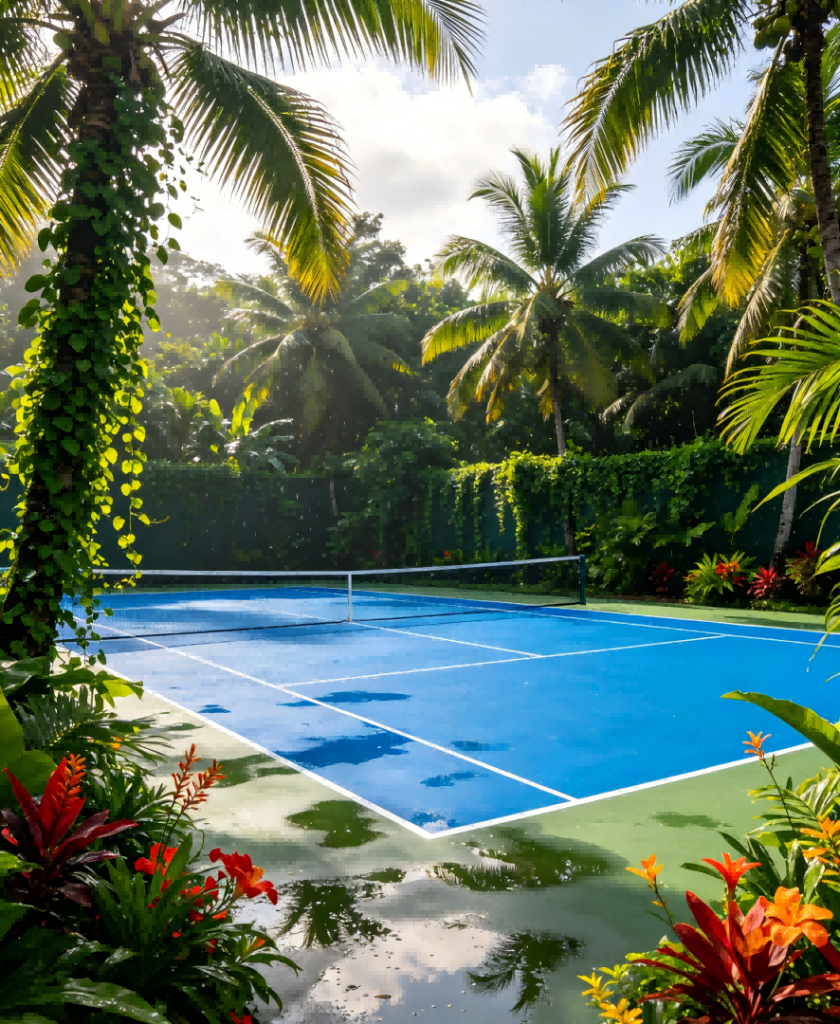
1. Cracking: How Temperature Ruins Acrylic Court in Tropical Southeast Asia
The biggest enemy of acrylic courts in Southeast Asia is temperature fluctuation. During the day, the sun bakes the court surface, pushing temperatures up to 60°C or higher. At night, temperatures drop sharply—sometimes by 15°C to 20°C in a single evening. This constant expansion and contraction puts enormous stress on ordinary acrylic, which is rigid and lacks flexibility. Over time, this stress leads to small cracks, which quickly widen when heavy rain seeps into the gaps.
But temperature isn’t the only culprit. We’ve found that 80% of cracking issues stem from poor base adhesion—especially on concrete or asphalt bases that aren’t properly prepared. Ordinary acrylic formulas use low-quality binders that don’t bond well with humid concrete surfaces. In our project for a primary school in Kuala Lumpur, Malaysia, the client initially chose a cheap ordinary acrylic court from a local supplier. Within 8 months, the surface started cracking along the edges, and by the 12th month, the cracks were wide enough to trip students. When we inspected the site, we found that the supplier had skipped the crucial step of applying a humidity-resistant primer, leading to poor adhesion between the acrylic and the concrete base.
In contrast, our acrylic court materials for Southeast Asia include a specialized tropical primer that bonds tightly to humid concrete, even in high-temperature environments. We recently completed a project for a community center in Bangkok, Thailand, where the court has withstood 2 years of extreme heat and rain without a single crack. The client told us, “We had tried two other suppliers before, and both courts cracked within a year. Your material is the first one that actually holds up to our weather.”
2. Fading: UV Damage to Acrylic Court in Tropical Southeast Asia
Southeast Asia receives some of the strongest UV radiation in the world—up to 10 times more than temperate regions. Ordinary acrylic courts use low-grade pigments that break down quickly under UV exposure, turning bright blue or green courts into dull, grayish surfaces within 6 to 8 months. This isn’t just an aesthetic issue; faded acrylic loses its structural integrity over time, becoming brittle and prone to chipping.
We’ve seen this firsthand with a client in Jakarta, Indonesia, who installed an ordinary acrylic tennis court for their club. Within 7 months, the court’s blue surface had faded to a pale gray, and the lines were almost unreadable. The club had to spend extra money to resurface the court, which disrupted their operations and frustrated members. The problem? The ordinary acrylic used by their previous supplier didn’t include UV-stabilizing additives—a critical feature for tropical climates.
Our acrylic court materials for Southeast Asia are formulated with high-quality UV-stabilized pigments and anti-aging agents that resist fading even in the harshest sun. A client in Ho Chi Minh City, Vietnam, has had our acrylic court for 3 years, and it still looks as vibrant as the day it was installed. “We host tennis tournaments every month, and the court’s color hasn’t faded at all,” they told us. “It’s saved us a lot of money on resurfacing.”
3. Bubbling: Humidity-Related Issues for Acrylic Court in Tropical Southeast Asia
High humidity is another silent killer of ordinary acrylic courts in Southeast Asia. Ordinary acrylic formulas don’t have effective moisture barriers, so when humidity levels are high, moisture seeps into the base layer of the court. When the sun heats the surface, this moisture turns into steam, creating pressure that pushes the acrylic layer upward—forming unsightly bubbles. These bubbles eventually burst, leaving potholes and uneven surfaces that are unsafe for players.
We encountered this issue with a sports complex in Penang, Malaysia, which installed an ordinary acrylic basketball court. After just 5 months of heavy rain and high humidity, the court was covered in bubbles, some as large as a basketball. The complex had to close the court for repairs, losing revenue and disappointing local residents. The root cause? The ordinary acrylic didn’t have a moisture barrier, so rainwater and humidity were able to seep into the base.
Our solution for tropical climates includes a built-in moisture barrier that prevents water and humidity from penetrating the court surface. We installed our acrylic court for a school in Phuket, Thailand, which experiences heavy monsoon rains and year-round high humidity. After 18 months, the court has no bubbles, no peeling, and remains smooth and safe for students. The school’s facilities manager said, “We were worried about the monsoons damaging the court, but your material has held up perfectly. It’s been a huge relief.”
Why “One-Size-Fits-All” Acrylic Courts Don’t Work in Tropical Southeast Asia
The core problem with ordinary acrylic courts in Southeast Asia is that they’re designed for temperate climates—where temperatures are mild, humidity is low, and UV radiation is weak. Suppliers who sell these materials in Southeast Asia don’t understand the region’s unique challenges, and they cut corners to keep costs low. This leads to a cycle of expensive repairs and replacements that could be avoided with climate-adapted materials.
In our 5 years in the region, we’ve learned that successful acrylic court projects in Southeast Asia require three key elements:
- A climate-adapted acrylic formula that resists heat, UV radiation, and humidity.
- Proper base preparation, including a humidity-resistant primer to ensure strong adhesion.
- On-site expertise to install the court correctly, accounting for local weather conditions.
Many of our clients came to us after having bad experiences with ordinary acrylic courts. One client in Kuala Lumpur told us, “We spent a lot of money on our first court, and it only lasted a year. We were skeptical at first, but your material has been a game-changer. It’s durable, it looks great, and it doesn’t require constant repairs.”
How to Choose a Durable Acrylic Court in Tropical Southeast Asia
If you’re planning a sports court project in Southeast Asia, don’t make the mistake of choosing ordinary acrylic. Here’s our practical advice, based on 5 years of experience:
1. Avoid “Cheap” Ordinary Acrylic
While ordinary acrylic may seem like a cost-effective option upfront, it will cost you more in the long run due to repairs and replacements. Invest in a climate-adapted acrylic formula that’s specifically designed for tropical weather—this will save you money and headaches down the line.
2. Look for Key Features
When choosing an acrylic court material for Southeast Asia, make sure it includes:
- UV-stabilized pigments to resist fading.
- A moisture barrier to prevent bubbling.
- Flexible binders to handle temperature fluctuations and avoid cracking.
- A humidity-resistant primer for strong base adhesion.
3. Work with a Supplier Who Knows the Region
Choose a supplier with on-the-ground experience in Southeast Asia. They’ll understand the local weather conditions, know how to prepare the base correctly, and can provide ongoing support if issues arise. We’ve worked on projects across Malaysia, Thailand, Indonesia, and Vietnam, and we’re familiar with the unique challenges of each country’s climate.
Final Thoughts
Investing in a climate-adapted solution for an acrylic court in tropical Southeast Asia means fewer repairs, less downtime, and a safer, more consistent playing surface for users.
Ordinary acrylic courts crack, fade, and bubble in tropical Southeast Asia weather not because acrylic is a bad material—but because ordinary formulas aren’t designed for the region’s extreme heat, high humidity, and strong UV radiation. After 5 years of supplying sports court materials in Southeast Asia, we’ve seen firsthand how climate-adapted acrylic can transform a project, saving clients time, money, and frustration.
If you’re tired of dealing with poorly performing ordinary acrylic courts, it’s time to switch to a material that’s built for Southeast Asia. Our acrylic court surfaces are formulated to withstand the region’s harshest weather, and we back them up with our on-site expertise and real client success stories.
Don’t let ordinary acrylic ruin your sports court project. Choose a material that’s as tough as Southeast Asia’s weather—and built to last. The right acrylic court in tropical Southeast Asia will serve your facility for years, with minimal maintenance and maximum performance.
We’ve spent years refining our materials to meet the dual demands of an acrylic court in tropical Southeast Asia and the strict performance standards set by the International Tennis Federation (ITF). Our ITF-certified formulations balance UV resistance, moisture stability, and consistent ball bounce—critical for both recreational and competitive play in the region—and our clients’ long-lasting courts speak for themselves.